The Education Series: Edition 1 - Budgetary Policy
- Hong Sheng QUAH
- Sep 3, 2020
- 6 min read
Updated: Sep 4, 2020
Welcome to the FIRST edition of the brand-new Education Series, aimed at enhancing YOUR exposure to economics. Over this series, we will cover a range of economic concepts that will aid your comprehension of this often-esoteric (but by no means dull!) field, and hopefully spur your interest to discover more. To begin with, we shall explore 'budgetary policy' to illustrate the RELEVANCE of economics to your daily life, as its implications should soon be quite apparent.
Background
For starters, it is useful to clarify the essence of what economics is - the allocation of resources (i.e. land, labour, capital and entrepreneurship) to balance competing interests. This can then be subdivided into two major categories, namely: microeconomics - the study of economics on a base level (e.g. consumer behaviour, preferences, biases, etc.), and macroeconomics - the study of economics on a holistic level.
For this article's purposes, we will be focusing on the latter, as 'budgetary policy' (also known as 'fiscal policy') fundamentally refers to a government's use of its money to achieve its desired effects on the economy (or in our case - Australia) as a whole.
Regardless of your current understanding of economics, the idea of money being a 'medium for exchange' would not be foreign to you. Likewise, this applies to the government too; i.e. the government needs to generate revenue to enable its expenditure.
Components of Budgetary Policy
Government Receipts: cash received by the government, predominantly composed of taxation income
Government Spending: cash paid by the government, usually to improve the living standards of its taxpayers
As you may have noticed, both of these directly impact on YOU - the taxpayer. Whether you periodically make income tax payments or receive welfare payments for unemployment, they are both products of the budgetary policy implemented by the government. Basically, it is a re-distribution of wealth to achieve a certain budget outcome (more on this later), as governments ultimately seek to achieve the utmost prosperity for its economy.
Equity or Equality?
As aforementioned, economics aim to balance competing interests, and governments can manipulate its budgetary policy to satisfy the various needs and wants of its people. Let's take the Australian Government for example...
The Federal Budget provides a picture of Australia's forecast financial performance and the government's fiscal policy for the forward years. The Budget includes estimates of government revenue and expenses for the Commonwealth over a specified period. - Australian Government | Department of Finance

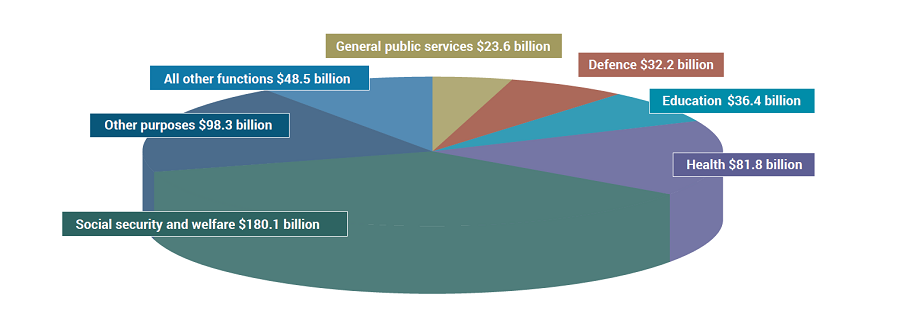
As seen in Figure 1, the Australian Government had forecasted for $234.1 billion to be generated via individuals income tax, and the progressive tax system in place effectively means that the richer one is, the more they fund the government's spending. Hence, this ensures that disadvantaged communities are able to meet their basic needs such as through government support [Figure 2] for their 'health' expenses, as well as their ability to access 'education'.
Despite this, it was previously noted that budgetary policy merely represents a mechanism for balancing 'competing' interests, meaning that any such spending would likely be met by some dissent. While economists can largely anticipate the general impact of economic decisions, the contrasting ideologies of individuals mean that it is often difficult to arrive at a consensus as to what constitutes a 'successful' outcome.
Differing Notions of Success
When formulating a 'budget', there is always heavy scrutiny on the expected 'budgeted outcome' (where a budget 'surplus' is resulted when government receipts exceed spending, and a budget 'deficit' is resulted when government spending exceed receipts). In other words, a budget surplus leads to 'leakages' from the economy as less money is available for consumer spending since greater amounts are paid in taxes, and smaller amounts are re-invested into the economy; conversely, a budget deficit leads to 'injections' into the economy as more money is available for consumer spending since smaller amounts are paid in taxes, and greater amounts are re-invested into the economy.
By controlling the amount of money available for consumption, the government can utilise its budgetary policy in either an 'expansionary' or 'contractionary' manner, where the former aims to stimulate economic growth with budget deficits, and the latter aims to restrain economic growth with budget surpluses. Despite the obsession of the Liberal government with budget surpluses, the optimal budget outcome is certainly not one that falls under either label, but rather depends on the state of the economy. This was exemplified by the current dynamic amidst the COVID-19 pandemic, where government spending is aplenty and tax cuts are flagged in a bid to fast-track the economy's recovery by encouraging consumption.
However, there are yet ethical considerations that would inform the best course of action. In such times of crises, multi-billionaire Jeff Bezos has just become the first person ever worth $200 billion (USD), and while this would technically contribute to the growth of America's struggling economy, it would barely serve as a source of comfort for the millions of unemployed Americans. Therefore, the onus is on the government to provide for the victims of capitalism as Bezos would undoubtedly see no issue with his tremendous wealth...

Up to this point, you are sure to have obtained an appreciation for the significance of the government's budgetary policy. However, we have mainly focused on the rationale behind these concepts, and you are sure to have burning questions about the practicalities behind them. We have compiled a set of responses to some likely questions that you may have (keep reading), but please do not refrain from contacting us via email or forum if you would like to have something else answered!
1. Why don't the government just print more money so it can spend more?
Contrary to popular belief, simply printing more money would NOT enable more expenditure as the increase in its quantity would result in a loss of value. As you may had wondered, the piece of paper in your pocket is essentially worthless, yet 'money makes the world go round'! Well, the simple reason for this is because that piece of paper can be exchanged for something valuable, and what constitutes being 'valuable' may vary according to personal preferences. Hence, an increase in the amount of money circulating within an economy would only be meaningful if it can be exchanged for something more valuable. After all, why wouldn't the baker sell a loaf of bread for a higher price if everyone is willing to pay?! Hypothetically, nobody becomes better off by paying $1000 for a loaf of bread as opposed to paying $1!
Similarly, the government is subject to these influences too. If it continually injects cash into the economy, the prices of goods and services would constantly increase as individuals are aware of the increased quantity of cash that can be exchanged for their product (i.e. good or service), while the total amount of production remains unchanged. As a result, product prices increase with the government simply obtaining the same product at a higher price, and this can in fact have severe ramifications (see hyperinflation in Weimar Germany).
2. How can I influence the budgetary policy of the government?
By now, you probably think that it is only fair that you get a say in the government's budgetary policy given that it is effectively your money at stake! Well, here are a few ways to sway the government:
Becoming a Member of Parliament
Since the government is responsible for devising a budget each year, the most direct way of getting involved is to be part of it! Who knows, you may well be the successor of Scott Morrison or the one to end 7 years of Liberal rule...
Contacting a Member of Parliament
If politics is not for you, that is perfectly understandable. Alternatively, you may choose to contact an individual Member of Parliament via their preferred method.
Stage/Attend a Protest
In Australia, the right to peacefully protest is protected by a number of international human rights treaties that Australia is a party to. For example, there have recently been a series of protests aimed at raising awareness for climate change, as activists attempt to encourage the government to shift towards renewable energy. Rally a group of people whom share a common interest as you, and make sure our elected representatives serve our interests! In fact, you may be able to do something about Mr Tehan's controversial cuts to university funding. With that being said, PLEASE be COVID-safe...
Overall, budgetary policy serves as a means of satisfying the various needs and wants within an economy. Through the allocation of government revenues in areas of government expenditure like healthcare, education and social security and welfare, the government can re-distribute wealth to allow the underprivileged population to sustain a basic standard of living.
While its one-size-fits-all approach may inevitably lead to accusations of unfairness, it must be noted that there is simply no way of meeting all conflicting interests due to the differing ideologies of people. Thus, budgetary policy quite often represents a necessary compromise as the holistic assessment of 'success' in macroeconomic policy more or less abide by the majority's conscience, for democratic governments exist to serve the majority's interests anyhow.
Hong Sheng QUAH
Founder and Chief Editor of Economics Discover
Coming Soon:
Also from the Author:
This is awesome! So much great detail and effort! :)